Explore Ethical and Responsible AI frameworks that embed trust, fairness, transparency, and accountability into enterprise AI systems — turning innovation into principled, human-centric intelligence.

Introduction: The New Currency of Trust
In the age of intelligent transformation, Ethical and Responsible AI is not optional — it is the cornerstone of trust, integrity, and sustainable enterprise innovation. Companies that embed ethical principles into AI systems build credibility, reduce risk, and establish digital conscience as a strategic differentiator.
-
Introduction: The New Currency of Trust
-
Redefining Intelligence: When Innovation Meets Conscience
-
The Business Case for Responsible Intelligence
-
The Five Pillars of Ethical and Responsible AI
4.1 Transparency
4.2 Accountability
4.3 Fairness
4.4 Privacy and Security
4.5 Sustainability -
Governance: The Architecture of Responsible Automation
-
Designing Human-Centric AI: Where Empathy Meets Engineering
-
Building the Enterprise Blueprint for Ethical AI
-
The Global Ethics Landscape: Aligning with Policy and Progress
-
The Convergence of Governance, Automation, and Trust
-
From Compliance to Conscience: The Cultural Shift
-
The Future: Designing Conscience at Scale
-
Conclusion: The Elegance of Ethical Intelligence
-
Key Takeaways
In the age of intelligent transformation, data is no longer the most valuable currency — trust is.
As artificial intelligence rewires the architecture of business, governance, and daily life, organizations are discovering that the future isn’t simply automated — it’s accountable.
Enter Ethical and Responsible AI — the next evolution of digital intelligence.
It’s not just a framework; it’s a philosophy. A vision that merges technological sophistication with human values, ensuring that as AI grows more powerful, it also grows more principled.
For forward-thinking enterprises, responsible AI isn’t a regulatory checkbox — it’s a strategic differentiator. It defines brand integrity, mitigates reputational risk, and establishes AI systems as extensions of corporate ethics. In an era of algorithmic influence, companies that embed morality into code aren’t just leading innovation — they’re architecting digital conscience.
1. Redefining Intelligence: When Innovation Meets Conscience
Artificial intelligence has surpassed its role as a computational tool; it has become an active participant in decision-making ecosystems — from diagnosing medical conditions to approving loans and forecasting markets.
But as its influence deepens, one truth becomes clear: power without responsibility erodes trust.
Ethical AI is the discipline of embedding moral, legal, and social awareness into algorithmic design.
Responsible AI is the operational framework that ensures those principles are applied consistently — across data pipelines, decision models, and deployment environments.
Together, they redefine how organizations innovate — not just what AI can do, but what it should do.
“The true sophistication of AI lies not in its speed or scale, but in its capacity to serve humanity without bias, harm, or opacity.”
2. The Business Case for Responsible Intelligence
In the enterprise ecosystem, ethics has shifted from philosophy to performance.
Every AI model that influences customer experiences, financial operations, or strategic outcomes carries moral and legal accountability.
According to Gartner, by 2027, 75% of large enterprises will operationalize AI ethics, risk, and transparency frameworks to manage trust at scale.
Why? Because ethical design is becoming a market advantage — one that strengthens brand credibility, customer loyalty, and investor confidence.
Key Business Imperatives
- Brand Equity: Companies known for ethical AI attract trust from consumers, regulators, and stakeholders.
- Risk Mitigation: Prevents reputational crises caused by algorithmic bias, data misuse, or opaque automation.
- Regulatory Readiness: Aligns enterprises with frameworks like the EU AI Act, OECD AI Principles, and NIST AI RMF.
- Operational Excellence: Responsible AI drives better model performance through transparency, feedback loops, and fairness audits.
Ethical intelligence isn’t a limitation; it’s a growth multiplier — the discipline that transforms innovation into sustainable influence.
3. The Five Pillars of Ethical and Responsible AI
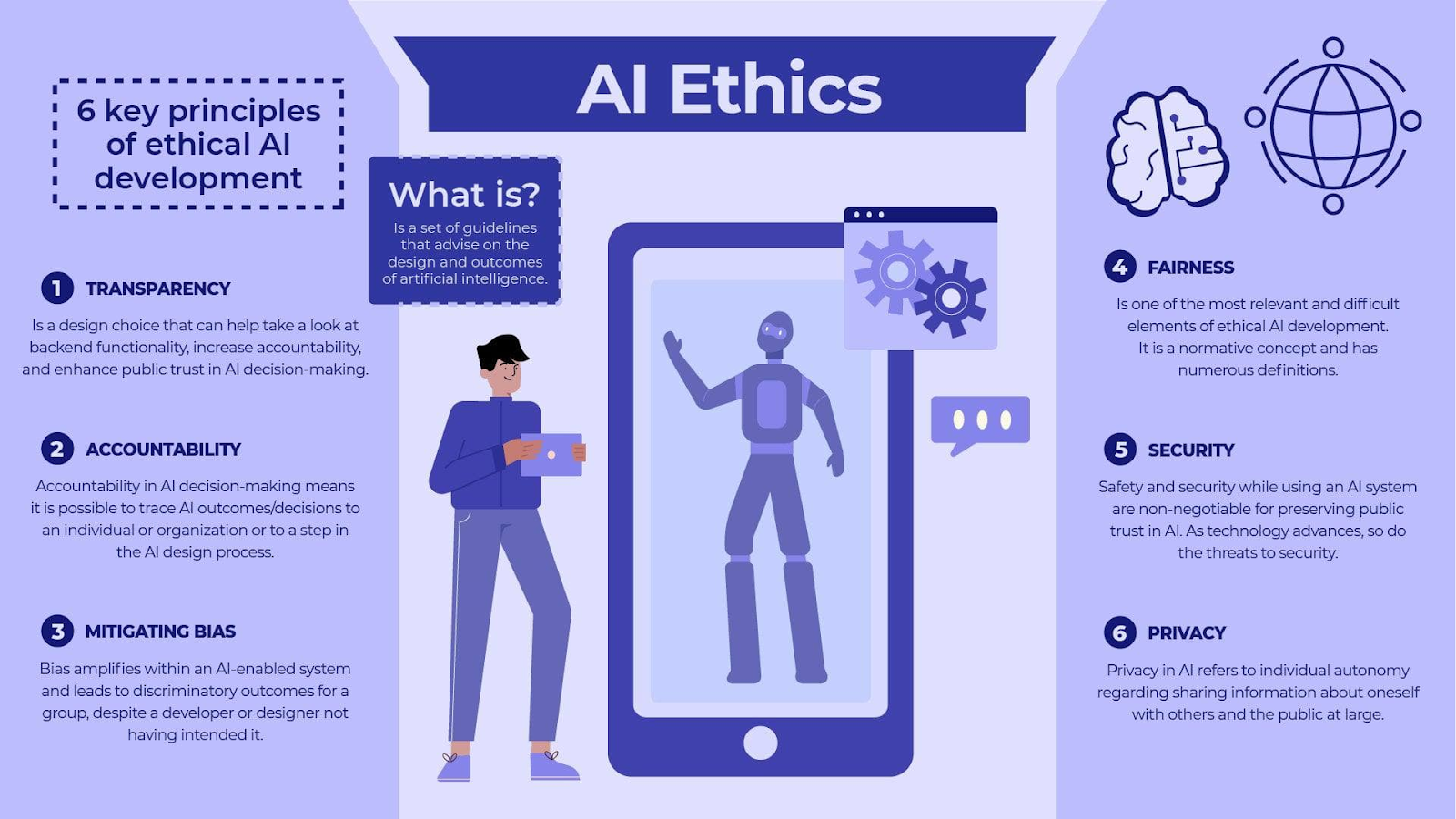
Modern enterprises are building AI systems not only to scale data but to scale values.
To achieve that, they’re aligning their frameworks around five foundational principles:
1. Transparency
AI systems must be explainable — both to users and regulators.
Explainability turns algorithms into partners, not black boxes. It ensures every decision can be traced, understood, and audited.
2. Accountability
AI accountability demands human oversight — a clear definition of ownership and responsibility.
Every automated decision should have a human signature behind it, ensuring moral and legal clarity.
3. Fairness
Bias in data leads to bias in outcomes. Responsible AI requires continuous bias detection, dataset diversification, and inclusive model training to ensure equitable decisions.
4. Privacy and Security
Protecting personal data is no longer optional — it’s the ethical backbone of AI deployment.
Responsible systems encrypt, anonymize, and minimize data collection while maximizing user control.
5. Sustainability
AI consumes vast energy and computing power. Ethical frameworks now extend beyond fairness to include environmental responsibility, optimizing models for efficiency and eco-impact.
“Sustainable AI is not just about saving energy — it’s about preserving human and digital ecosystems alike.”
4. Governance: The Architecture of Responsible Automation
For enterprises, ethics must be operationalized, not just idealized.
That’s where AI Governance Frameworks come in — systems that monitor, evaluate, and manage AI models through their entire lifecycle.
AI Governance in Action
A mature governance framework includes:
- AI Ethics Committees: Multidisciplinary teams overseeing fairness, inclusion, and compliance.
- Model Risk Management: Continuous monitoring for drift, bias, and performance degradation.
- Compliance Dashboards: Real-time visibility into AI operations and regulatory alignment.
- Accountability Structures: Clear reporting lines for AI-driven outcomes.
Platforms like IBM Watson OpenScale, Microsoft Responsible AI Toolkit, and Google’s Model Card Framework have become gold standards — blending automation with auditability.
Governance is where enterprise AI becomes trustworthy by design, ensuring that decisions made by machines reflect the values of their creators.
5. Designing Human-Centric AI: Where Empathy Meets Engineering

Technology without empathy is machinery.
Human-centric AI reframes innovation through the lens of emotional intelligence, inclusivity, and user empowerment.
Enterprises are now designing AI experiences that augment human capability — not replace it.
From conversational systems that respect tone and emotion to decision engines that weigh ethical trade-offs, responsible design turns AI from a system of control into a system of care.
Human-in-the-Loop Intelligence
Embedding human oversight throughout the AI lifecycle — from data labeling to deployment — ensures contextual awareness and moral reasoning remain central.
Inclusive Design Methodology
Diverse design teams, global data sampling, and intersectional testing bring multiple worldviews into algorithmic logic — preventing one-dimensional decision-making.
“Human-centric AI isn’t about making machines more human — it’s about making humans more empowered through machines.”
6. Building the Enterprise Blueprint for Ethical AI
Enterprises must move from ethical intention to ethical implementation.
That means creating a living ecosystem of frameworks, automation, and continuous improvement.
Key Steps Toward Responsible AI Maturity
- Define Ethical Principles: Establish organization-wide values that guide all AI initiatives.
- Operationalize Governance: Build cross-functional ethics boards and compliance tools.
- Measure & Audit: Regularly evaluate model fairness, explainability, and impact.
- Educate & Empower: Train teams to recognize and mitigate bias or misuse.
- Evolve Continuously: Adapt frameworks as laws, technology, and social norms evolve.
Ethics must be agile — evolving as rapidly as the algorithms it governs.
7. The Global Ethics Landscape: Aligning with Policy and Progress
Responsible AI is no longer self-regulated — it’s becoming institutionalized.
Governments and international bodies are establishing guardrails to ensure AI development respects human rights and societal stability.
Key Global Initiatives
- EU AI Act: Categorizes AI risks and enforces transparency obligations.
- OECD AI Principles: Promotes fairness, robustness, and accountability in design.
- UNESCO AI Ethics Framework: Encourages global ethical standards for sustainable AI.
- NIST AI Risk Management Framework: Provides operational guidelines for enterprise AI assurance.
Forward-thinking enterprises see these frameworks not as constraints, but as blueprints for leadership.
Compliance transforms into competitive credibility — proof that innovation is rooted in responsibility.
8. The Convergence of Governance, Automation, and Trust
As enterprises scale AI, the challenge is balancing automation with accountability.
Next-generation AI ecosystems now embed self-regulating intelligence — systems that audit their own logic, flag anomalies, and explain decisions autonomously.
This convergence is giving rise to Autonomous Governance Engines — digital oversight systems that continuously evaluate ethical performance using:
- Real-time fairness metrics
- Model explainability dashboards
- Automated bias correction loops
- Predictive compliance alerts
Through intelligent governance, enterprises are building AI that self-governs, maintaining transparency even as systems grow more complex.
9. From Compliance to Conscience: The Cultural Shift
Ethical AI is not just a technical construct — it’s a cultural transformation.
The most successful enterprises are those that treat responsibility as a core business value, not a department.
Leaders are fostering a culture of algorithmic empathy — where data scientists, designers, and strategists collaborate to build systems that align with humanity’s collective goals.
“Responsible AI doesn’t begin in the codebase. It begins in the boardroom.”
This cultural alignment ensures every AI initiative — from automation to analytics — operates under a shared ethos: profit with purpose, progress with principles.
10. The Future: Designing Conscience at Scale
The next decade of AI innovation will not be defined by faster models or larger datasets, but by how deeply ethical intelligence is embedded into the system’s DNA.
The Next Frontier
- Neuro-symbolic Ethics: AI that reasons through moral logic.
- Emotional AI Regulation: Guardrails around affective computing and sentiment analysis.
- Federated Accountability: Shared global standards for ethical AI infrastructure.
- AI Sustainability Indexes: Measuring carbon and ethical footprints of machine learning models.
As we move toward autonomous AI, the responsibility to encode conscience becomes non-negotiable.
Enterprises that master this will not only lead in innovation but will define the moral architecture of the digital age.
Conclusion: The Elegance of Ethical Intelligence
Ethical and Responsible AI is not about slowing innovation — it’s about refining it.
It transforms artificial intelligence from a mechanical system into a moral ecosystem — one capable of scaling empathy, equity, and enlightenment.
Enterprises that build AI with integrity will command not just markets, but movements.
They’ll lead a future where every algorithm serves a higher purpose — not just optimizing profits, but optimizing humanity itself.
“The future of AI will not be written in code alone — it will be written in conscience.”
Key Takeaways
- Ethical AI = Competitive Advantage: Trust drives adoption and loyalty.
- Governance is Non-Negotiable: Frameworks transform ideals into systems.
- Human-Centric Design Leads the Future: Empathy scales intelligence responsibly.
- Compliance Evolves into Conscience: True innovation begins with integrity.